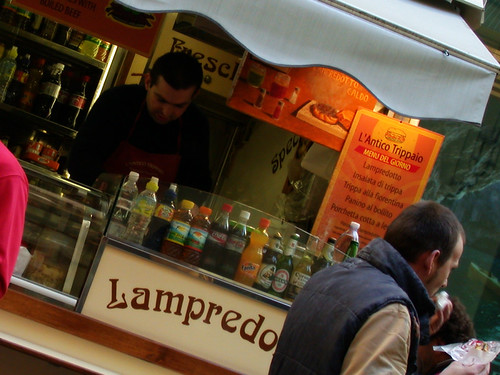
Mention lampredotto to a visitor and you'll usually see a polite flicker of alarm. Mention it to a Florentine and you'll get a speech. This is the city's real street food, older than any pizza by the slice, sold from little carts and kiosks to bankers, builders and students alike. It's tripe, specifically the fourth stomach of the cow, simmered for hours until meltingly soft, sliced, piled into a crusty roll and drenched in its own broth. Brave? A little. Worth it? Completely.
What exactly is it?
Cows have four stomach compartments. Lampredotto comes from the fourth, the abomasum. It's darker and more tender than the honeycomb tripe most people know, with a ruffled, folded surface. Its name is said to come from its resemblance to the lampreda, the lamprey eel, once common in the Arno and eaten in Florence.
Florence's tripe sellers, the trippai, have been part of city life for centuries. Their carts, often painted and polished, park in the same piazzas year after year. Inside the Mercato Centrale, the stall known as Nerbone has been serving lampredotto and boiled beef sandwiches since the nineteenth century.
How to order like a local
At the cart, the lampredottaio fishes a piece out of a steaming pot, chops it on a board, and asks two questions:
- "Bagnato?" Should he dip the top half of the roll in the broth? The answer is yes.
- "Verde e piccante?" Green sauce and chilli oil? Yes, and yes.
The roll is a semelle or crusty bun, and the green sauce is a tangy mix of parsley, capers, garlic and olive oil. Some carts also serve lampredotto in a bowl, alla fiorentina, stewed with tomato.
The trick is the dunk: the top of the bun goes into the broth. Without that, it's just a sandwich.
How it's made at home
In New York, lampredotto (abomasum) can be ordered from butchers who handle offal, especially in neighbourhoods with Italian, Latin American or Asian butchers, sometimes sold as "reed tripe." It usually comes cleaned and par-boiled. You simmer it gently in a broth with tomato, onion, celery, carrot and parsley for a couple of hours until tender. The broth becomes rich and savoury, which is exactly what you want for dunking.
The recipe
For the lampredotto
- 1 kg lampredotto (abomasum tripe), cleaned
- 1 onion, halved
- 1 carrot
- 1 celery stalk
- 2 ripe tomatoes (or 2 tbsp tomato paste)
- 1 small bunch parsley stems
- 1 tbsp coarse salt and a few peppercorns
- 6 crusty bread rolls
For the salsa verde
- 1 large bunch flat-leaf parsley
- 1 tbsp capers, rinsed
- 1 small garlic clove
- 2 anchovy fillets (optional)
- 1 tbsp red wine vinegar
- 6 tbsp extra-virgin olive oil
- Chilli oil, to serve
Method
- Rinse the tripe well under cold water. Put it in a large pot with the onion, carrot, celery, tomatoes, parsley stems, salt and peppercorns. Cover with cold water by 5 cm.
- Bring slowly to a simmer, skim any foam, then cook very gently, partly covered, for 2–2½ hours until completely tender when pierced.
- Meanwhile, make the salsa verde: finely chop the parsley, capers, garlic and anchovies (or pulse briefly in a processor), then stir in the vinegar and oil. Season.
- When ready to serve, lift the lampredotto out of the broth, chop into bite-sized pieces and season with salt and pepper.
- Split each roll. Quickly dip the cut side of the top half in the hot broth. Pile the bottom with lampredotto, spoon over salsa verde and a few drops of chilli oil, and close.
- Eat immediately, standing up, ideally with a small glass of red wine.
Food safety: buy tripe from a reputable butcher, keep it chilled and cook it thoroughly. See our disclaimer.