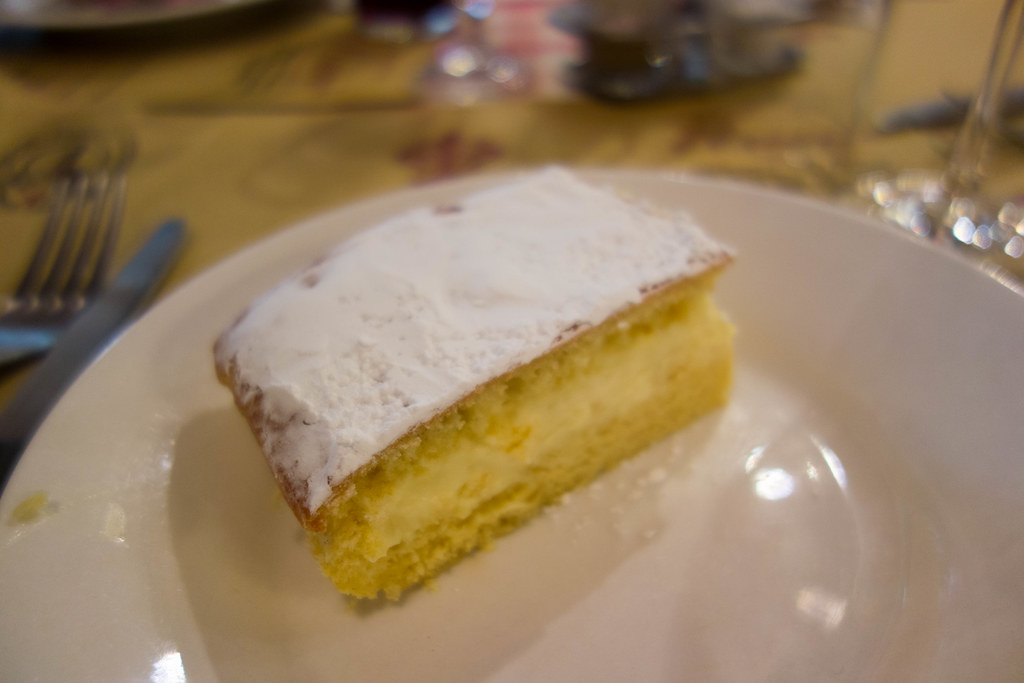
For a few weeks every winter, the windows of Florentine bakeries fill with low, golden rectangles of cake dusted with snowy sugar, each one stamped with a cocoa lily, the symbol of Florence. This is schiacciata alla fiorentina, the city's Carnival cake. It's soft, airy and perfumed with orange, and it disappears from the shops almost as soon as Lent begins.
A cake for Carnival
Carnival is the season of excess before the forty days of Lenten fasting, and every Italian city has its fried and baked treats. Florence's is this one. "Schiacciata" usually means a flat bread (the word comes from schiacciare, to squash), and the Carnival version may once have been an enriched bread dough. Over time it became a true cake: light, fluffy and only about three centimetres tall. You'll find it from around Epiphany until Martedì Grasso, Fat Tuesday.
The lily on top
The decoration is what makes it unmistakably Florentine. Bakers cover the cake with powdered sugar and then dust cocoa through a stencil of the giglio, the red lily that has been the emblem of Florence for centuries and appears on its coat of arms and football shirts. At home, a paper stencil works perfectly. We've included a tip below.
Orange, sugar and a cocoa lily: Carnival in Florence fits in a baking tin.
How it's made in Florence
Traditional recipes used lard (strutto), which gives a tender, slightly rich crumb, and some bakers still do. Many modern home cooks use a neutral oil or a mix of oil and butter. The essentials are plenty of orange zest and juice, a little vanilla, and well-whipped eggs for lightness. Bakeries sometimes sell versions split and filled with whipped cream or custard, which purists consider a later invention. Delicious, but not "real" schiacciata.
The recipe
Ingredients
- 3 large eggs, at room temperature
- 180 g granulated sugar
- 1 large orange: zest and 80 ml juice
- 80 ml mild olive or sunflower oil (or 70 g melted lard)
- 100 ml whole milk, lukewarm
- 1 tsp vanilla extract
- 250 g plain flour ("00" or all-purpose)
- 16 g baking powder (one Italian sachet, about 3½ tsp)
- 1 pinch salt
- Powdered sugar and cocoa, to decorate
The scaler adjusts quantities, but keep the pan size in proportion: for 16 slices, use two pans.
Method
- Heat the oven to 180°C (350°F), conventional (170°C fan). Grease and line a 30 × 20 cm baking tin with parchment.
- Whisk the eggs and sugar with an electric mixer until pale, thick and tripled in volume, about 8 minutes. This gives the cake its lightness.
- With the mixer on low, pour in the oil in a thin stream, then the milk, orange juice, zest and vanilla.
- Sift the flour, baking powder and salt together and fold in gently in two or three additions until just smooth.
- Pour into the tin, level the top and bake for 25–30 minutes, until golden and a skewer comes out clean. Don't open the oven in the first 20 minutes.
- Cool in the tin for 10 minutes, then turn out and cool completely on a rack.
- Dust generously with powdered sugar. Lay a paper lily stencil in the centre and sift cocoa over it, then lift the stencil off carefully.